
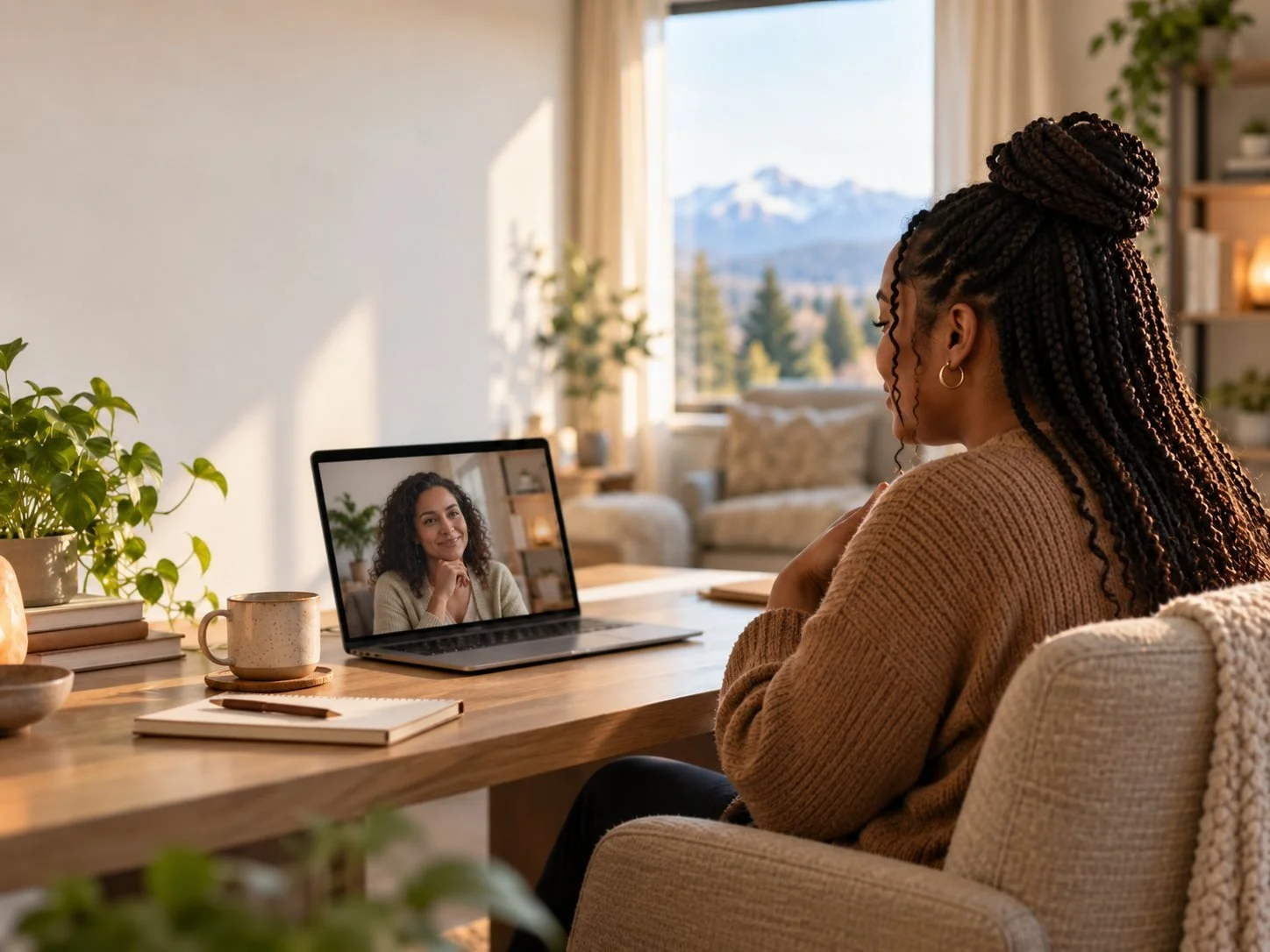
If something painful still follows you around, you may have thought about trauma therapy and then wondered how it could work through a screen. It's a fair question. Trauma work asks you to feel safe enough to face hard memories, and a video call can seem like an odd place for that.
For many people in Calgary, online sessions turn out to be one of the easier ways to start. You don't have to drive across the city after a hard session, sit in a waiting room, or explain an appointment to anyone. You meet from a room you already know.
Here's what online trauma therapy actually looks like, what the research says, and how to get set up.
It starts with safety, not memories
Good trauma therapy doesn't begin with the worst thing that happened. The first sessions are about getting to know you: what you're carrying, what's helped before, and what you want to feel different.
Then we build ways to settle your body when feelings rise, such as slowing your breath, grounding through your senses, or picturing a calm place. Some people spend a few sessions here; others need longer. That pace is part of the treatment, not a delay.
What a session can look like
Say a car crash on Deerfoot Trail left you tense every time you merge. In an online session, you'd join from a private room. We'd check in on your week and how settled you feel today.
If you're ready, we might work on one part of the memory. With EMDR, that can mean following a moving dot on your screen or tapping your shoulders in a slow left-right rhythm while you notice what comes up. We pause often, and you can stop at any time. Before the session ends, we always come back to calm.
You stay in charge
You decide what we work on and when. You don't have to describe every detail out loud. If a session feels like too much, we slow down.
Does it work as well online?
For trauma-focused therapy, the research is encouraging. In a randomized trial of 132 Veterans with PTSD, Prolonged Exposure therapy delivered by video at home reduced PTSD symptoms as much as in-person sessions, and the results held at six months (Acierno et al., 2017). Fewer large trials exist for online EMDR, but the early findings are promising.
Online therapy isn't right for everyone. If you don't have a private space, are in an unsafe living situation, or need more support than weekly sessions can offer, we'll talk about what fits better.

Getting set up at home
A private room where you won't be overheard. Some people use a parked car or a friend's place.
Headphones, so the session stays between us.
A stable connection on a laptop or tablet. A phone works, but a bigger screen helps with EMDR.
A plan if the call drops. We agree on this in the first session.
Something for after. A short walk, a warm drink or quiet time helps you transition before getting back to your day.
You need to be physically in Alberta during each session.
Who you'd see
Marissa Whalley, MC, R.Psych, is based in Calgary and trained in EMDR. She sees individuals aged 16 and older, and couples. Kyle Poon, M.Ed., R.Psych, is an EMDRIA Approved Trainer and Consultant who sees adults across Alberta, and Marissa can consult with him on EMDR within the practice.
Sessions are $235 with Marissa and $250 with Kyle, for 50 minutes. We bill most insurance plans directly. See fees and insurance.
Common questions
Do I need a referral? No. Some insurance plans ask for one, so check yours.
How long does trauma therapy take? It depends on what you're working on. A single event may take fewer sessions than long-standing or childhood trauma.
What if I get overwhelmed during a session? We stop and help you settle. You're never left mid-memory when the call ends.
Is it EMDR or something else? Often EMDR, but not always. We choose the approach with you.
If you're ready to talk, book a free 15-minute phone consultation. You can also read more about online EMDR in Calgary.
If you're in crisis, call or text 9-8-8 any time, or call 911. In Calgary, the Distress Centre is available 24/7 at 403-266-4357.
Sources
Acierno, R., et al. (2017). A non-inferiority trial of Prolonged Exposure for PTSD: In person versus home-based telehealth. Behaviour Research and Therapy.